

Sustainability is Good for the Planet – and Good for Business
Stakeholders are continuously placing a higher importance on sustainable business practices; pushing companies to increase profits as well as make a positive impact on the environment. With rising energy costs, regulatory reporting, and consumer expectations, it is more important than ever before to understand how to make your business as efficient and environmentally sustainable as possible.
Sustainability is prioritizing the preservation of ecosystems and biodiversity by limiting the amount of waste, extraneous use of natural resources and energy, and emissions one creates. In practice this could look like reducing spoilage, increasing asset life, maximizing energy efficiency, or improving inventory utilization. All these things help decrease energy use to help efficiently allocate resources, all leading to less emissions and waste. By implementing sustainable business practices, not only will your company be more ethical and socially responsible, but it can also help increase your company’s profits and yield. The foundation for accomplishing this feat is through an effective Enterprise Resource Planning (ERP) platform!
How will an ERP platform help?
Centralize and Connect Data
With an ERP platform, businesses can track resource allocation and operations like never before, allowing operations leaders and general managers to make accurate, near real-time decisions. ERPs connect all aspects of manufacturing, supply chain, and inventory operations and data. Through a single, consolidated view in an ERP, inefficiencies are magnified, and waste management becomes simplified. Labor, energy, and material allocation can be visible in near real-time.
Identify Inefficiencies
ERPs also can track materials from the start to the end of production. Seeing how specific materials travel through production helps management see how resources are being used. For instance, if a feed mill inputs 100 tons of ingredients but only produces 97 tons of finished feed, an ERP will identify where the 3 tons are getting lost along the line. Whether it’s ingredient waste or machine issues, the ERP makes the problem visible which allows leaders to make informed decisions that will increase overall yield. This allows businesses to cut costs and reallocate resources to save money and time whenever an anomaly occurs.
Plan for the Future
Optimizing logistics and supply chain through an ERP will cut waste by reducing energy consumption, time, and unnecessary material use. In the case of grain elevators, an ERP can be utilized to help accurately time truck deliveries and outbound shipments while managing productive inventory inside. Knowing when demand will ebb and flow limits overstock and spoilage of product. This helps keep products fresh for customers, eliminates wasting resources due to shifts in demand, and helps with sustainability goals throughout a company. Not only do ERPs show what is currently happening in production, but they can forecast demand for the future.
Compare Month-over-Month Data
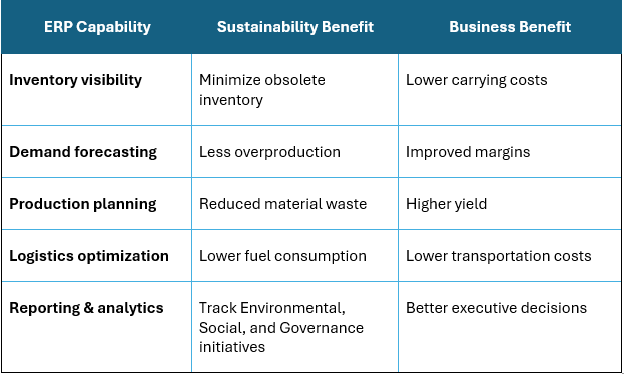
With centralized ERP data, creating compliance reports has never been easier. With views like energy and water use, yield percentage, and raw material waste, businesses have the competitive advantage of comparing month-over-month on improving profit, yield, and sustainability efforts. Sustainable businesses are often more profitable because they operate more efficiently.
For example:
Copyright Captios Partners – All rights reserved
Conclusion
No matter where your company is positioned in the market, a well-functioning, modern ERP system will help empower business leaders to make informed decisions, drive up operational and resource efficiency, and ultimately environmental sustainability, not to mention the likely increase in profitability is nice. Sustainability is no longer separate from operational excellence. Organizations that can better understand and optimize how resources flow through their business are often the ones that become both more environmentally responsible and see profitability increase from these investments.
At Captios, we believe sustainability begins with visibility. Before organizations can reduce waste, optimize resources, or improve environmental performance, they need accurate, connected operational data. The Captios approach focuses on aligning people, processes, and technology, so sustainability initiatives deliver measurable business value.
Captios Partners works with companies to bring structure and clarity to operational and technology decisions. If you are ready to reduce waste to increase yield at your company, reach out directly to Michael at pelsoci.michael@captiospartners.com.
Recent Comments