

Ask a feed mill owner what their new ERP will cost and you will usually hear the number written on the software quote. That number is accurate, but partner services, data cleanup, integrations to the scale house and the batching system, and the hours your own people spend away from their day jobs all land on the same bill. When those costs show up halfway through the implementation, the project starts borrowing from operations to finish.
This is not a rare problem. Industry surveys consistently find that many ERP projects run over budget, and the reasons tend to repeat. Either the functional scope grows after the project starts, as new processes or reports get added, or the team discovers technical needs nobody accounted for, such as an integration, a third-party app, or extra data migration work. For a business running on feed or grain margins, an overrun like that can erase a year of the gains the new system was supposed to deliver.
The answer is not to budget more. It is to budget completely.
Start with a percentage of revenue
For a $10M to $150M feed or agribusiness company, we recommend planning a one-time project budget of 1% to 3% of annual revenue. After go-live, plan on another 0.25% to 0.75% of revenue each year to run and support the system. That range comes from our own project experience and published benchmarks. The actual range will depend on a few factors.
Size is the first. A $15M company still has to migrate data, test the system, and train its people, so fixed costs take a bigger share of revenue. For this reason, smaller businesses should plan toward the top of the range.
Complexity is the second. Multiple legal entities, multiple plants, or a business that runs feed, grain, and agronomy under one roof all push the number up. A very complex business, such as one handling grain trading, feed manufacturing, medicated products, trucking, and growing operations, may need more than one system, which adds cost.
Your starting point is the third. A company moving off spreadsheets or recovering from a failed implementation has more data to clean and more processes to define. That puts it near the top of the range. A company coming off a well-maintained ERP with clean customer, item, and formula data can plan towards the middle or even the bottom.
Know where the money goes
Once you have an overall number, break it into five buckets. Implementation services from your partner typically take 40% to 60% of the one-time budget, covering configuration, project management, testing, and go-live support. Generally, implementation services often run about twice the annual software subscription. First-year software, including any ag-specific add-ons, usually accounts for 10% to 15%. Data migration and integrations take another 10% to 15%.
The last two buckets are the ones many small businesses leave out. Internal time and backfill (10% to 15%) pays for temporary help or overtime so your controller and plant manager can actually work on the project. Contingency (15% to 20%) is money held back for the scope nobody could see on day one.
Ongoing costs deserve the same attention. Microsoft Business Central, a common choice at this size, lists at $80 per user per month for its Essentials tier and $110 for Premium, before any ag add-on. Additionally, it’s important to consider partner support, testing for Microsoft's regular updates, and new reports as the business grows and trusted data gets used more frequently to enable better operations.
The costs generic ERP guides miss
Many ERP cost guides are written for distributors and light manufacturers. Feed and ag businesses carry extra work those guides rarely mention.
Start at the scale house. Inbound grain tickets and outbound feed tickets need to flow into the ERP without anyone retyping them, and that integration is rarely free. Batching and mill automation systems need to connect to production orders and inventory, which is often custom work. Formulation software needs to hand formulas and ingredient costs to the ERP cleanly every time a formula changes.
Grain accounting is one place generic ERPs often fall short as well. Contracts, settlements, deferred-price agreements, and storage charges require either an ag-specific add-on or a lot of configuration. Cooperatives add patronage and equity tracking. Medicated feed brings lot traceability and FDA requirements that need their own setup and testing.
Then there is the calendar. A go-live during harvest or spring rush puts your team in a strained position, and slipping to the next quiet window adds partner fees while extending the cost of running your old system. Pick the go-live window before you sign, and build the project plan backward from it.
What this looks like for a $40 million feed mill
Take a single-site feed mill with $40 million in revenue, about 30 system users, a scale house, and a batching system. At 1.25% of revenue, its one-time budget is $500,000, split like this:
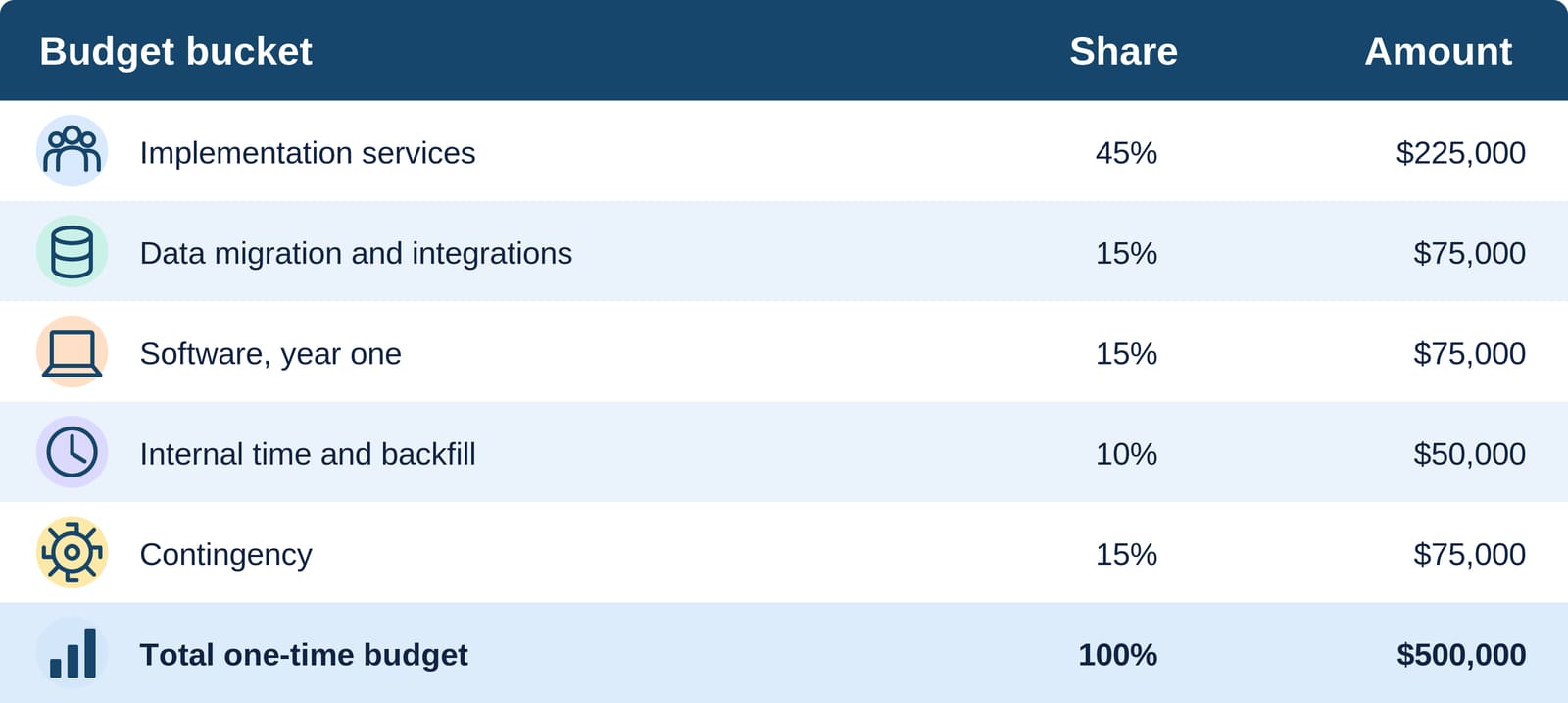
After go-live, the mill plans on about $120,000 a year, or 0.3% of revenue, for subscriptions and support.
Now suppose the vendor quotes come in at $375,000. That covers the first three rows of the table. The remaining $125,000 is the money most projects end up finding mid-stream, and it is the reason so many of them run over.
Before you talk to vendors
Set your overall number first, then build all five buckets, including backfill and contingency. List every integration your operation runs today, from the scale house to payroll, and give each one a line. Budget years two and three before you compare vendors, not after. And choose a go-live window that stays clear of your busiest season. A complete budget will not necessarily make your ERP project cheaper, but it will prevent it from surprising you.
Captios Partners helps feed and agribusiness companies build realistic ERP budgets before vendor selection begins and will walk you through the process of how to do it along with how to go about choosing the right vendor that aligns with your business needs and your budget.
If you are starting to plan, reach out directly to Michael at pelsoci.michael@captiospartners.com to talk it through.